

In our series Salary Stories , women with long-term career experience open up about the most intimate details of their jobs: compensation. It’s an honest look at how real people navigate the complicated world of negotiating, raises, promotions, and job loss, with the hope it will give young women more insight into how to advocate for themselves — and maybe take a few risks along the way.
Additionally, we are joining forces with SoFi for the next few months to bring you career tips and coaching. We got the lowdown from SoFi’s career coaches who recommend:
Before a job interview, prepare ten questions to ask the hiring manager. It’s okay if you already know the answers to some of them. You can learn as much from how they answer as what they say.
Been in the workforce for at least eight years and interested in contributing your salary story? Submit your information here.
Previously, we talked to a brand manager in Portland, a consumer goods sourcing manager in Minneapolis, and a records and compliance coordinator in Boulder.
Age: 33
Current Location: Seattle, WA
Current Industry & Title: eCommerce, Senior Program Manager
Starting Salary: $42,000 in 2008
Current Salary: $150,000
Number Of Years Employed: 11
Biggest Salary Jump: $40,000 in 2011 (from $43,000 to $83,000)
Biggest Salary Drop: $9,000 in 2018 (from $147,000 to $138,000; no change in base, but total compensation changed because of bonuses)
Biggest Salary Negotiation Regret: "I taught for two years at a public school and then changed to a charter school. I literally did not ask about money — I was just thankful that I was offered a job and was ready to sign anything. I had absolutely no conversation about salary, benefits, retirement, or anything along those lines.
"I knew roughly what I was making because I got a paycheck every month, but my annual salary never registered until I looked at my retirement-account statement at the end of the year and realized how much I had been making — which was less than the job I had changed from.
"I was doing a lot more work, so my regret was that I never even thought to ask about salary. Looking back, there was a big mindset shift for me. Because at that point in my working life, I still thought that getting a job was a gift from an employer. It wasn’t about me bringing skills, experience, or value to my employer. So I didn’t even ask questions. Ten years later, I have a very different perspective: I know what I am worth."
Best Salary-Related Advice: "Ask for what you’re worth. Women are often not socialized to advocate for ourselves, so when I say this I mean: Understand that in an employee-employer relationship, you are very valuable because you are doing the work that allows your employer to accomplish what it is they want to accomplish. Have an understanding of the job that you do, what the value and salary of that job are, and then use that as a base to have a conversation about what you are paid.
"For a long time, I felt ashamed or uncomfortable having this conversation because I came from being a teacher. But I got to a point where I realized I needed to advocate for myself and be paid for what I was worth. There is nothing wrong with asking for more money — everyone else around you is doing that, why shouldn’t you?"

"I joined Teach for America, a nonprofit organization that places recent college graduates who don’t have education degrees into teaching positions in underserved schools. I found out a very small percentage of Latinxs earn college degrees, and there are similar discrepancies for other communities of color, and I got really angry and fired up. I thought this discrepancy was absurd and wanted to do something about it. I wanted to teach in a region where there was a large Latinx population and where I could be a role model for young Latinas. So I decided to apply, and I got in.
"Teach for America set up interviews with me and different districts they partner with. There was no negotiation as there was a very strict salary ladder, so I went in and my salary was determined by my years of experience and my education. Once I received the offer, I just accepted."

"I was given a standard raise, going into my second year. I didn’t have an ability to negotiate.
"My first year, I taught tenth-grade students, and the majority of my students passed a very important state test. My second year, I moved up to the eleventh grade, so I taught the same group of kids.
"I was living on a cattle ranch in a tiny rural town on the border, and I wanted a change of scenery. I was ready to move back to a city. I saw the principal reprimand a student and some other unethical issues that I didn’t agree with, and I decided I couldn’t continue to be complicit in that behavior. I wanted experience working in a charter school, so I started applying for other jobs elsewhere in Texas and around the country."

"I accepted a position with a charter school in Houston. Compared to the school where I had been teaching, I suspected that this one would be a better place for kids. I didn’t even think to negotiate on salary — I thought I was lucky to get the job. I was amazed they would hire me, because the school was so great. I didn’t realize until years later that I made less in Houston than I did in south Texas.
"Once I started, the job was a lot more challenging than I thought it would be. I taught 11th- and 12th-graders again. But at this school, I taught 110-minute classes to kids who read at or above grade level and teaching, compared to the last school where I only taught 45-minute classes to 11th-grade kids who were reading, on average, at a third-grade level.
"This job required a total mindset shift and ended up being a lot harder than what I had been used to, teaching-wise, including the fact that I was writing my own curriculum.
"I realized pretty early on that I didn’t want to sign up for another year. I was overwhelmed by the workload — working 90-hour weeks. I didn’t have time to have a social life and wasn’t feeling very successful as a teacher, either. I was frustrated, and I didn’t get the support I needed.
"I went to my principal and told him that I needed to change my schedule around. He was kind enough to take one of my classes away, so I only taught 11th grade the second semester. I got the impression they wouldn’t want to renew my contract, and I wasn’t very interested anymore, so I started looking for new jobs that weren’t teaching."

"I wanted to change careers because I was burned out on teaching. I also wanted to move closer to my family in Atlanta. I had posted my résumé on monster.com and was applying for all of these jobs. Then I got a random phone call from someone who saw my résumé. She worked at an industrial supplier and said she’d be interested in interviewing me for a management-development program.
"I had a screener call and was going to be in Atlanta, where they were based, over Christmas break. I did an on-site interview before Christmas. It was an intense five-hour behavioral interview. Right after Christmas, I got a call from their HR department, and they offered me the job. I said I needed some time to think it over.
"They offered me $75,000, plus a $7,000 bonus. I tried to play it cool, but I was floored at the idea of that much money. I remember hearing the salary and being knocked off my feet. I couldn’t believe that someone would pay me that much!
"I emailed them back and accepted it. The hours at this job were more relaxed than my teaching position, and the pay was much better.
"When I first started, I was basically putting numbers into a spreadsheet and doing analysis work. I was relieved, honestly. I had felt so overwhelmed in my previous job that this was a welcome change. Then it got harder and more complex once I started managing people and overseeing a department."

"I received a merit-based raise in June and was promoted in October (14% overall). My employer also gave a profit-sharing bonus every year, but you had vest into it. I didn’t end up negotiating, since I felt ashamed that I was making so much money for a job I felt was less important than teaching.
"When I was teaching, I was doing something vital; it was important for me to be there every day. This didn’t seem vital. But the way I talked to myself about it was that I had an opportunity as a manager to shape the way people in my department experienced work and to build autonomy, but it was never as vitally important as teaching."

"I received a merit-based raise and moved to Chicago for a different position within the same company. I asked (weakly) for a raise based on a cost-of-living change because Chicago was more expensive than Atlanta. I felt like negotiating was something I should do, so I did it.
"I felt kind of awkward because I knew I could survive on the money I had been making. My boss told me my compensation was fine, and I felt kind of crappy; I didn’t feel super great about it after. The result was that I didn’t get a raise, but I made the move for career reasons. And continued to feel guilty about how much money I was making."

"I made slightly less this year because our profit-sharing bonus was lower. I received an 8.5% merit-based raise, bringing me to $99,300.
"I moved back to Atlanta from Chicago because I really hated the winter. I had to go to work during a polar vortex, and I told myself: never again. I moved back to warmer climates and bought my first house.
"Later in the year, I raised a salary concern with HR because I was managing people who made 95% of what I did. I didn’t think that pay differential was appropriate, because I had significantly more responsibility than my direct reports. I didn’t get the raise, and the conversation was highly unsatisfying.
"HR said there was some wage compression that had to happen because they raised their starting salaries, but I didn’t push too hard because I felt guilty about asking for more money when I made so much, though the principle still bothered me."

"I received an annual 8.5% merit-based raise. Our profit-sharing bonus was again smaller than the previous year. The increases I received were higher than the average, which I was happy about.
"I again noticed that my direct report, with his new raise, would make almost as much money as me per year. I made a flippant comment to my boss (‘Gee, he’ll make as much as me!’), and he just laughed it off.
"This particularly stung, because I was a woman in a position at a time when I worked with very few women. It felt very much like a boys’ club at that time, and no one seemed to care. I didn’t end up pursuing a salary change, but I wish I had pushed harder on this disparity because it would have been an important conversation to have.
"At this point, I already wanted to move on. I was really close to totally vesting into my retirement fund at this point, so I decided to ride things out until I was totally vested."

"I got a smaller merit-based raise this year, and profit sharing was lower. I vested into my retirement mid-year and waited until December to quit, because if I were employed in December I would get my yearly bonus.
"Once I left, I had to pay back a first-time-homeowner loan I got from my employer. They used my last month’s salary to pay off my loan, and because of my bonus, it kind of balanced out."
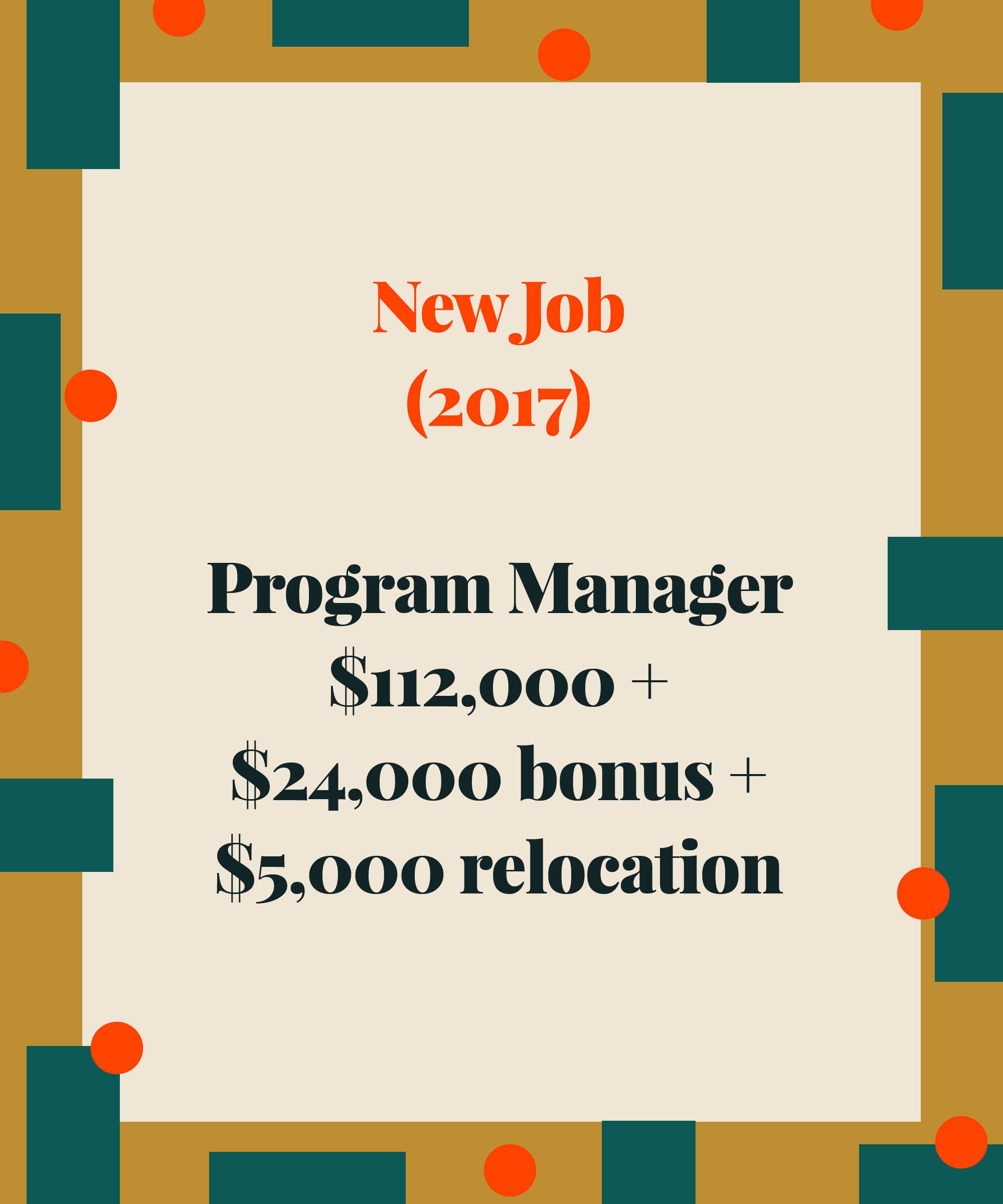
"I had been in conversations with this new company since August but ended up pushing my start date until January. They initially offered me a $93,000 base, and I told them that was way less than my previous base salary. They tried to talk to me about total compensation, including signing bonus and stock, but none of that was real money to me. The real money was in base salary, which was what I was going to live on. And I stood firm on that.
"We went back and forth on that, and they reallocated signing bonus and stock units and upped the base. Once I felt comfortable with the salary portion, we talked about the start date.
"This negotiation process was difficult in that it felt uncomfortable to keep going back and saying it wasn’t enough, but I was in a good position to do this because I was in good standing at my job and didn’t have to quit. I had a lot of room to explore other opportunities, so it was pretty easy for me. If they didn’t give me what I wanted, I just wouldn’t take it. I think this is the best negotiating technique: As long as you feel like you can walk away, you’re in a good position.
"Ultimately, I accepted, and I moved to the West Coast. The compensation is different for this job than my previous jobs. I received a signing bonus and restricted stock units that I have to vest into. My company talks about "total compensation" instead of base pay (like my previous company).
"I negotiated on this salary, but I didn’t totally understand what a total compensation salary meant. Initially, they offered me about $14,000 under my previous employer’s base salary, but with $24,000 in signing bonuses and stock to be paid over four years. I held strong for a base salary that matched my current salary; the salary negotiations stretched over a few weeks. In retrospect, I should have negotiated for more restricted stock units or a larger signing bonus.
"Overall, I think this was a great move for me to make. I moved from a medium-size family-owned business to a giant behemoth. I got way more responsibility, I work at a much larger company, and I get to live on the West Coast, which is an experience that I wanted."

"I was promoted in April 2018 and received a 10% raise. My gross salary was less than 2017’s, because that year included relocation funds. Without those funds, I made about $8,600 more this year compared to last.
"I am at a point now where I am really considering what I want to do in my career. I make good money, but what I’m doing is not something I’m super passionate about. Over the past three years, I’ve been saving up money so that I can take a sabbatical and travel.
"I am trying to find the right time, but I’m enamored by the idea of taking time off and being able to do whatever I want for a little while and not working. I’m not sure what the future holds, but I think it would be interesting to explore the nonprofit sector, though it can be hard to get your foot in the door.
"I’ve also been toying with the idea of doing some entrepreneurship. I’m a plus-size person and plus-size clothing is, by and large, horrible. I’d love to create a clothing line where there are no style compromises."
Like what you see? How about some more R29 goodness, right here?
Money Diaries, Couples Edition: A Week In D.C.
How To Answer Those Tough Situational Questions In A Job Interview
6 Easy Ways To Make Some Quick Cash
Source: Refinery29 – Ludmila Leiva